Railixoon
Loom Session
Loom Session
Couldn't load pickup availability
- 📁 Digital file available after purchase
- 🗂️ Long-term availability
- 🔒 Secure checkout
- 🗓️ Content updated in 2026
Self-paced learning overview
1. Problem Statement
At this stage of Ruby learning, a learner can often write small code fragments, but larger examples create a need for better logic separation. Repeating similar actions in different places makes code harder to read. Classes and objects may feel clear in theory, yet become more difficult during practical use. It is also not always obvious where a method should be placed, what data it should receive, and how parts of a program should interact. Loom Session is created to help learners calmly review these links through study examples.
2. Solution
Loom Session presents Ruby through topics connected with logic reuse, classes, objects, and small structured examples. The course helps learners see how one part of code can support another without unnecessary repetition. The materials cover methods, object logic, data inside classes, and reading code from several connected parts. Practical tasks are arranged so learners can move from simple objects to more organized study scenarios. Loom Session is suitable for those who want to better understand the inner links of Ruby code.
3. What's Inside
- Module 1: Structure Echo Review — how to review previous topics and notice where repeated logic appears in code.
- Module 2: Class Shape Basics — how classes are created, what role they play, and how they help organize study examples.
- Module 3: Object Logic Room — how objects work, how they store data, and how they interact with methods.
- Module 4: Instance Data Notes — how to use internal object values and understand where they are needed.
- Module 5: Method Placement Practice — how to decide where a method should be placed and which part of logic it should describe.
- Module 6: Repeated Logic Cleanup — how to notice repetition, move repeated actions into separate methods, and make examples neater.
- Module 7: Small Object Scenario — how to create a short study scenario with a class, objects, methods, and simple data.
- Module 8: Structure Reading Session — how to read Ruby code from several connected parts and explain how they work together.
4. Who is this for?
✅ A suitable fit if you...
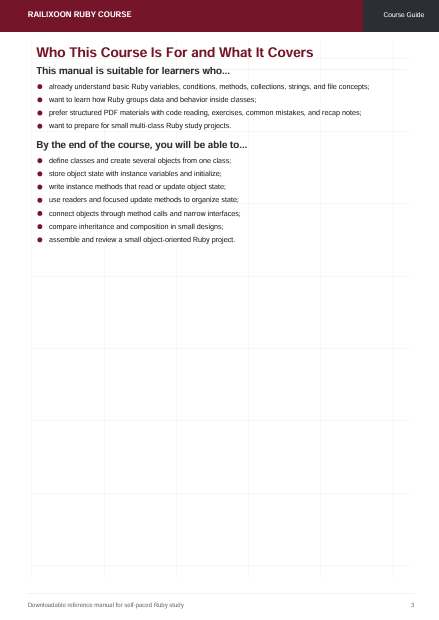
- are already familiar with Ruby methods, conditions, loops, and collections;
- want to better understand classes and objects;
- notice similar logic repeating in your study examples;
- want to place methods more neatly;
- want to read code made from several connected parts;
- are looking for a tier focused on structure and object logic.
❌ Not for you if...
- you are only starting to learn Ruby;
- methods and arrays are still difficult for you;
- you want only a short introduction without object topics;
- you need materials without practical exercises;
- you do not plan to review your own code structure;
- a foundational tier with a simpler topic set fits your current stage better.
5. What You'll Learn
- how to find repeated logic in Ruby code;
- how to create simple classes;
- how objects and internal data work;
- how to place methods in a clearer structure;
- how to reduce repetition in study examples;
- how to create short scenarios with classes and objects;
- how to read code from several connected parts;
- how to explain the role of each part in a small Ruby program.
6. Return Terms
Railixoon tiers may include a 30-day return period according to the store terms. Loom Session includes materials about classes, objects, and Ruby code structure, so it is worth reviewing the module list, topic description, and checkout page rules carefully before placing an order. All return details should follow the terms stated on the store page.
7. Certificates
After finishing Loom Session, the learner receives a certificate of completion for the course on classes and objects. The certificate reflects work with class definitions, object creation, instance data, the initialize method, and object methods. It marks an important stage in studying object-based Ruby structure.
How are Railixoon courses structured?
How are Railixoon courses structured?
Railixoon courses follow a steady structure: from introductory explanations to practical tasks and short summaries. Each tier differs by the amount of materials, the number of modules, and the depth of topics. You can study at your own pace and return to the materials whenever it fits your schedule.
Are these courses suitable for people who are just starting with Ruby?
Are these courses suitable for people who are just starting with Ruby?
Yes, the Railixoon course line includes tiers for different learning stages. Starter options help learners understand basic concepts, syntax, and Ruby logic. More advanced tiers are designed for those who already have some experience and want to work with more detailed structures.
Share